
Why Your Hospital Needs a Dedicated Digital Marketing Strategy

Why Your Hospital Needs a Dedicated Digital Marketing Strategy

By Mindread Technologies  |  Healthcare Branding & Digital Marketing Specialists  |  Madurai & Chennai

Introduction

Picture this: a patient in Madurai wakes up at 11 p.m. with acute abdominal pain. She does not know any doctor personally. Her first instinct is not to ask a neighbour — she opens Google and types “best gastroenterologist near me”.

Three hospitals appear on the map. One has 120 reviews and a 4.7 rating, a modern website with clear doctor profiles, and an active Instagram that she recognises. The other two have 8 reviews each, no social media presence, and websites that do not even load on her phone.She calls the first hospital.

That is the reality of Indian healthcare in 2025. Clinical excellence alone no longer fills OPDs. A dedicated hospital digital marketing strategy is now the single most important competitive advantage a hospital can have — and most hospitals in India still do not have one.

This blog will show you exactly why a random, unplanned approach to digital marketing is costing your hospital patients every single day — and what a proper, dedicated strategy looks like.

What You Will Understand After Reading This

• Why "doing some social media" is not a strategy — and why it fails
• The 5 specific ways hospitals lose patients without a digital strategy
• What a dedicated hospital digital marketing strategy actually contains
• The difference between hospitals with a strategy and those without one
• How to build your hospital's strategy in 6 clear steps
• The Mindread Technologies approach to healthcare marketing in Tamil Nadu.

Section 1: The Hard Truth — Most Hospitals Have Activity, Not a Strategy

Walk into the marketing office of a typical Indian hospital and ask: "What is your digital marketing strategy?" Most times, you will hear one of these answers:
• "We post on Facebook and Instagram regularly."
• "We run Google Ads when we launch a new department."
• "We are on Justdial and Practo."
• "Our IT team manages the website." 

These are activities. They are not a strategy.

A strategy is a connected, goal-driven plan where every activity serves a specific objective, every rupee spent can be tracked to a patient outcome, and every channel reinforces every other channel. Without it, hospitals are simply making noise online — and noise does not bring patients.

1.1 The Real Cost of Having No Strategy

image 2026 04 19 005829019

These numbers represent real patients choosing other hospitals over yours — every single day. The cost of inaction compounds every month you delay.

1.2 Why Random Digital Activity Backfires
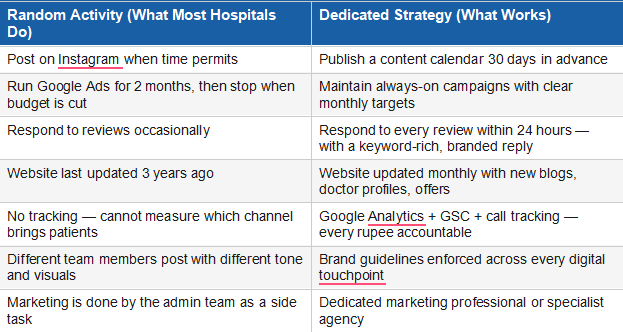
image 2026 04 19 010132615

Section 2: The 5 Ways Hospitals Lose Patients Without a Digital Strategy

2.1  You Are Invisible When Patients Search for You

The majority of patient journeys in India now begin with a Google search. If your hospital does not rank in the top 3 results for your key specialities in your city, you are invisible to the largest and fastest-growing patient acquisition channel available.

This is not a technical problem — it is a strategy problem. Hospitals without a search strategy have not claimed their Google Business Profile properly, have no location-specific landing pages, and publish no content that Google can index and rank.

Local Reality Check for Tamil Nadu Hospitals

Search "best hospital in Madurai" on Google right now. Count how many hospitals appear in the Map Pack. Those 3 hospitals are capturing 44% of all clicks for that search. If your hospital is not there, every patient searching that phrase is a patient your competitor is seeing.

The good news: with the right local SEO strategy, most Madurai hospitals can enter the Map Pack within 90 days.
2.2  Competitors With Weaker Clinical Outcomes Are Outranking You

This is the most frustrating reality for doctors and hospital administrators: a hospital with inferior facilities and less experienced doctors is consistently getting more patient inquiries because it has invested in digital marketing.

A hospital with a 4.8-star Google rating (even if that rating was built over 3 years), a fast-loading website with clear doctor profiles, and an active blog answering patient questions will outrank a clinically superior hospital that has none of those things.

Digital marketing does not replace clinical excellence — it amplifies it. The strategy makes sure patients can discover how good you actually are.

2.3  Your Online Reputation Is Being Shaped Without You

Whether or not your hospital has a digital strategy, your patients are talking about you online. They are leaving reviews on Google, posting on Facebook, and discussing their experiences on hospital-rating platforms.

Without a reputation management strategy, you have no way of knowing what is being said, no system for responding to negative experiences, and no process for encouraging satisfied patients to share their feedback publicly.

The Asymmetry of Online Reviews

An unhappy patient is 3X more likely to leave a review than a happy one. Without a proactive review generation strategy, your rating will naturally drift toward the negative — even if 90% of your patients are satisfied.

2.4  Your Marketing Budget Has No Accountability

Hospitals that market without a strategy typically spend on:

  • Newspaper advertisements they cannot track
  • Hoardings and banners with no ROI measurement
  • Random Google Ads campaigns with no conversion tracking
  • Social media boosting with no audience targeting

A dedicated digital marketing strategy changes this entirely. Every channel can be measured. Every rupee can be tracked to a patient inquiry. You know exactly which campaign brought in how many patients and at what cost per acquisition.

2.5  Your Patient Retention Is Lower Than It Should Be

Most hospitals think of digital marketing only as patient acquisition. The hospitals that grow fastest use digital channels for patient retention as well — follow-up reminders, health tips, seasonal health camps, anniversary greetings for long-term patients.

Acquiring a new patient costs 5X more than retaining an existing one. A digital strategy that includes retention — WhatsApp follow-up sequences, email newsletters, loyalty health packages — is one of the highest-return investments a hospital can make.

Section 3: What a Dedicated Hospital Digital Marketing Strategy Actually Looks Like

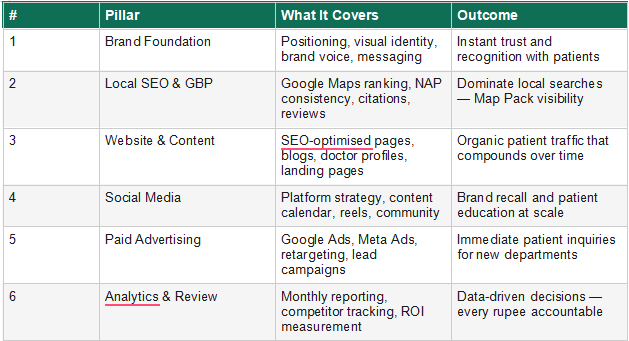
A dedicated strategy is not a document that sits in a folder. It is a live, active plan with 6 interconnected components — each one reinforcing the others.

3.1  The 6 Pillars of a Hospital Digital Marketing Strategy

image 2026 04 21 001202860

3.2  How the 6 Pillars Work Together — A Real Example

Here is how a hospital in Madurai used all 6 pillars together. A patient searched "best orthopaedic hospital in Madurai" on Google:

1. Local SEO placed the hospital in the Map Pack — the patient saw the listing.
2. Reviews strategy showed 94 reviews and a 4.8-star rating — the patient clicked the listing.
3. Website loaded in under 2 seconds and showed a detailed orthopaedics page with the surgeon's profile and patient testimonials — the patient was convinced.
4. Social media — the patient recognised the hospital from Instagram content she had seen before — increasing trust.
5. WhatsApp CTA on the website — the patient WhatsApp'd to book an appointment — the conversion happened within 4 minutes.
6. Analytics tracked this entire journey — the marketing team knew exactly which channels contributed to the booking. 

Without any one of these pillars, the patient might have been lost. The strategy creates a complete, interconnected patient journey from search to appointment.
Section 4: How to Build Your Hospital's Digital Marketing Strategy in 6 Steps

Step 1: Define Your Hospital's Digital Marketing Goals

Before anything else, answer these three questions:

  • What do we want to achieve?(More OPD footfall, more surgical inquiries, better brand awareness, stronger online reputation)
  • In which specialities?(Orthopaedics, cardiology, maternity, general medicine — prioritise based on capacity and revenue per patient)
  • In which geographies?(Your own city first, then satellite towns within your natural referral radius)

Vague goals produce vague results. Specific goals — “Generate 30 new patient inquiries per month for our cardiac department from Madurai and surrounding districts” — produce measurable campaigns.

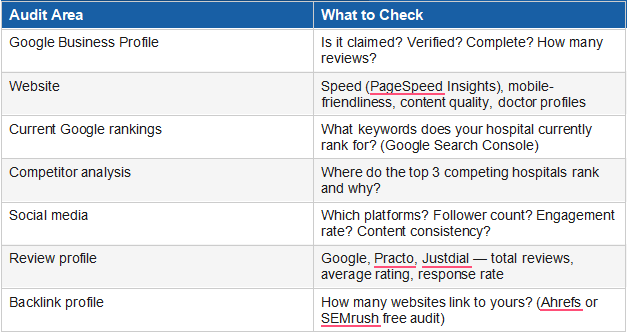
Step 2: Conduct a Digital Audit — Know Where You Stand Today

Before building, diagnose. A proper digital audit covers:

image 2026 04 21 002036169
Step 3: Define Your Target Patient Persona

Example Patient Persona — Orthopaedics Department, Madurai

  • Name (fictional):  Rajan, 52
  • Location:  Madurai city / Dindigul
  • Problem:  Chronic knee pain affecting daily life and work
  • How he searches:  “best knee replacement hospital Madurai” on Google — mostly on mobile
  • What he trusts:  Peer reviews, doctor credentials, before/after stories, clear cost information
  • How he wants to contact you:  WhatsApp or phone call — not forms
  • Decision timeline:  3-6 weeks from first search to booking

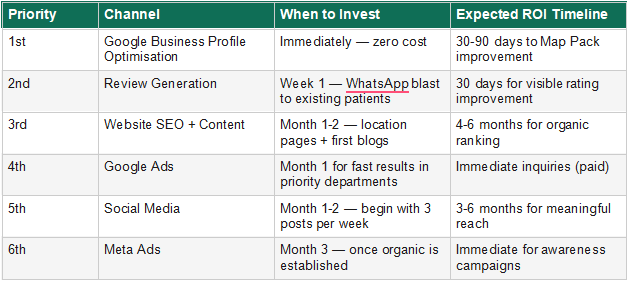
Step 4: Build Your Channel Strategy — Prioritise by ROI

Not every channel deserves equal investment at every stage. Here is the recommended priority order for most Indian hospitals:

image 2026 04 21 002926992
Step 5: Set Up Tracking and Measurement From Day One

A strategy without measurement is guesswork. Set these up before launching any campaign:

  • Google Analytics 4— track every visitor’s behaviour on your website
  • Google Search Console— see which keywords bring patients to your site
  • Google Tag Manager— track WhatsApp clicks, call button clicks, form submissions as conversions
  • Google Business Profile Insights— monthly map views, searches, calls, direction requests
  • Call tracking— if you have multiple phone numbers, track which channel generates each call
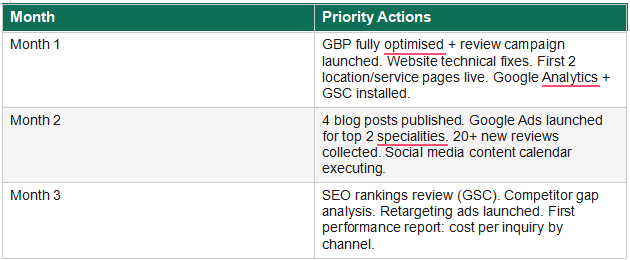
Step 6: Create a 90-Day Execution Plan With Monthly Milestones

Break your strategy into a 90-day sprint. Month 1 = foundation. Month 2 = content and visibility. Month 3 = growth and measurement. Review at 90 days and adapt.

image 2026 04 21 003349362

Section 5: Common Objections — And Why They Do Not Hold Up

“We do not have the budget for digital marketing.”

Reality: Google Business Profile optimisation, review generation, and organic content publishing are either free or very low cost. A hospital spending ₹20,000/month on digital marketing done right will consistently outperform a hospital spending ₹2,00,000 on newspaper ads with no tracking. The question is not budget — it is allocation.

“We already have an IT person who handles this.”

Reality: SEO, content marketing, paid advertising, and reputation management are specialist disciplines — not IT functions. Your IT team’s job is to keep the website running. Your marketing strategy’s job is to make sure the right patients find it. These are different skills.

“We get enough patients from referrals.”

Reality: Referral-dependent hospitals are one retired doctor or one unhappy referral source away from an OPD crisis. Digital marketing builds a second, independent patient acquisition channel that is not dependent on any individual relationship. The best hospitals in India use both.

“Digital marketing takes too long to show results.”

Reality: Google Ads can generate patient inquiries within 48 hours of launch. A properly optimised Google Business Profile can enter the Map Pack within 60 days. Organic SEO takes 4-6 months — but it then delivers free patient traffic indefinitely. The only strategy that truly takes too long is the one you keep delaying.

Section 6: How Mindread Technologies Builds Hospital Digital Marketing Strategies

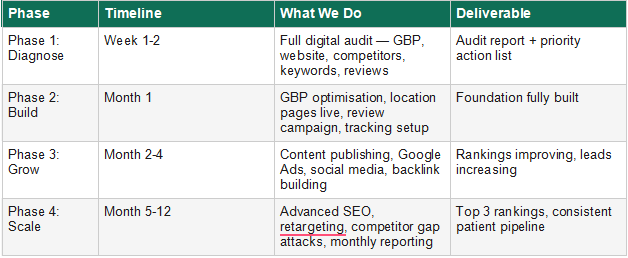
Mindread Technologies is Tamil Nadu’s specialist healthcare branding and digital marketing agency — with dedicated expertise in hospital marketing across Madurai and Chennai. We do not offer generic digital marketing. Every strategy we build is designed specifically for the healthcare sector, with an understanding of patient behaviour, clinical sensitivity, and the regulatory context of Indian healthcare

6.1 The Mindread 4-Phase Hospital Strategy Framework
image 2026 04 21 004047419

 Mindread Client Result: From 12 Reviews to the Map Pack in 4 Months

A multispeciality hospital in Madurai approached Mindread with a simple goal: “We want more patients from Google.” Here is the 4-month outcome:

  • Google reviews:  12 → 74 (implemented WhatsApp review request workflow)
  • Google Map Pack:  Not visible → Position 2 for “multispeciality hospital Madurai”
  • Website organic traffic:  Near zero → 1,200 sessions/month
  • Monthly patient inquiries from digital:  0 → 28 per month
  • Google Ads cost per inquiry:  ₹165 against average consultation value of ₹800+

This was achieved with a dedicated strategy — not random activity.

6.2  What Makes Mindread Different for Healthcare Clients

  • Healthcare-only focus:  We do not handle e-commerce, fashion, or unrelated verticals. Healthcare is our speciality.

  • Tamil Nadu market expertise:  We understand the Madurai and Chennai patient, the local competition, and the Tamil-language search behaviour.

  • Full-stack capability:  Branding, SEO, paid ads, social media, web design, and software — all under one roof. No coordination overhead for you.

  • Transparent reporting:  Monthly performance report with rankings, traffic, inquiries, and cost per lead — no jargon, just numbers.

  • 300+ clients served:  Mindread has helped businesses across Tamil Nadu grow their digital presence. Our healthcare clients see an average 3X increase in online inquiries within 6 months.

Conclusion: Strategy Is Not Optional Anymore

The Indian healthcare market is undergoing a permanent shift. The hospitals that build systematic, data-driven, patient-centric digital marketing strategies today are going to dominate their local markets for the next decade.

The hospitals that continue to treat digital marketing as an afterthought — posting occasionally, running disconnected ad campaigns, ignoring their Google Business Profile — are going to find it progressively harder and more expensive to compete for the same patients.

The question is not whether your hospital needs a digital marketing strategy. Every piece of evidence says it does. The question is: are you going to build one before your competitor does? 

Get Your Free Hospital Digital Marketing Audit — Only 5 Spots Per Month

Mindread Technologies will analyse your current GBP profile, website SEO, competitor rankings, and review profile — and deliver a personalised strategy blueprint for your hospital. No cost. No obligation.

📞  Call / WhatsApp: [Your Phone Number]

🌐  mindreadtechnologies.com

📧  mindreadtechnologies@gmail.com

📍  Madurai & Chennai, Tamil Nadu

→  Also read: How to Market a Hospital in India — The Complete 2025 Guide

Frequently Asked Questions (FAQ)

What is a hospital digital marketing strategy?

A hospital digital marketing strategy is a structured, goal-driven plan that outlines how a hospital will use digital channels — search engines, social media, paid advertising, content, and email — to attract new patients, retain existing ones, and build its online reputation. Unlike random marketing activity, a strategy connects every channel to a measurable patient outcome.

Why do hospitals specifically need a different marketing strategy from other businesses?

Healthcare marketing operates under unique constraints that require specialist knowledge. Medical advertising guidelines in India restrict certain types of claims. Patient privacy (consent for testimonials, before/after content) must be carefully managed. The patient decision journey is longer and more trust-dependent than a typical product purchase. And the keywords and content that rank in healthcare require medical accuracy alongside SEO expertise.

How much should a hospital budget for digital marketing in India?

A useful benchmark for Indian hospitals is 2-4% of annual revenue allocated to marketing, with the majority directed toward digital channels in 2025. For a small hospital or clinic (revenue under ₹2 crore annually), a ₹20,000-₹40,000/month digital marketing budget managed by a specialist agency will deliver meaningful results. Larger multispeciality hospitals should budget ₹1,00,000-₹5,00,000/month depending on the number of specialities being promoted.

Can a small clinic or single-speciality hospital benefit from digital marketing?

Absolutely — in fact, single-speciality clinics and small hospitals often see faster results than large multispeciality hospitals because they can focus their entire strategy on one set of keywords and one patient persona. A Madurai dermatology clinic targeting “skin specialist in Madurai” with a well-optimised GBP, 50+ reviews, and a targeted Google Ads campaign can dominate that niche within 60-90 days.

Should a hospital hire an in-house marketing team or use an agency?

For most hospitals with fewer than 200 beds, an experienced specialist agency delivers better results at lower cost than building an in-house team. A good healthcare marketing agency brings SEO expertise, paid ads management, content writing, and graphic design — skills that would require 3-4 full-time hires to replicate internally. As the hospital grows and marketing becomes a core function, a hybrid model (in-house coordinator + specialist agency) works best.

Latest update - Learn Digital Marketing

Scroll to Top